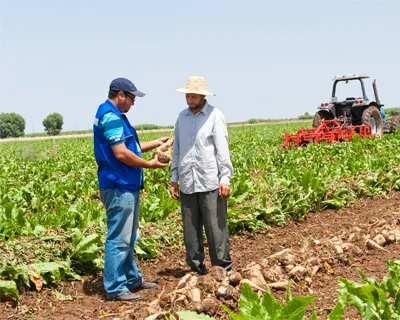
A majority of the farmers in the world are smallholder farmers. It is estimated that there are over 608 million family farms, occupying 70–80% of the world’s farmland and producing around 80% of the world’s food in value terms. They are the driving force to achieve food security. Unfortunately, they do not receive adequate financial, technological, and other assistance at the pre-production and post-production levels to optimize the quality and quantity of yield.
The aggregation model holds the power to flip this scenario. It enables smallholder farmers to form a cooperative, collective, or federation to produce, distribute, and market together for achieving economies of scale. This model can provide a structure to the input and output market, which is currently fragmented. Fundamentally, aggregation brings several smallholder farmers together to commercialize at a large scale which otherwise would be challenging for them on a standalone basis.
Several agricultural countries in the world are already leveraging the aggregation model. For example, the Government of India has been pushing the formation and promotion of 10,000 Farmer Producer Organisations (FPOs). Australia has an aggregation of farmers engaged in carbon farming. A large farmers’ cooperative in East and Southern Africa has a membership of more than 7000 rice farmers.
Here are some ways the aggregation model can uplift smallholder farmers and the agriculture sector at large.
Quality Inputs
Farmers often have to shell out more money to buy high-quality seeds, fertilizers, pesticides, tools and machinery, or other inputs. If they buy sub-standard inputs, it will adversely impact their yield. Sometimes, they even incur heavy losses if they get tricked into buying counterfeit inputs.
The aggregation model allows the growers to bargain collectively to buy the best-quality inputs in bulk at affordable prices and maximize their output.
Access to Credit
The financial inclusion of smallholder farmers is still a major concern for the global economy. They are often denied credit from formal financial institutions due to their high-risk profile or lack of proper documentation or collateral. Even if they manage to get credit from banks or private moneylenders, they have to pay exorbitant interest which worsens their debt trap.
Farmers who are members of an agricultural collective can enable them to fill the financial gap. They can secure financial assistance at a marginal interest rate with easy repayment terms. They can utilize the funds to invest in quality inputs, buy crop insurance to mitigate climate change risks, or for any other farm-related purpose.
Technology Adoption
A majority of smallholder cultivators are either unaware of agri-tech innovations, lack convenient access, or are unable to afford them.
Aggregation can facilitate the integration of technology and capacity building on their farms to boost efficiency and productivity. When farmers see their peers switching to digital practices and improving their livelihood, they will be more willing to break their mindset barriers and adopt technology.
Seamless Market Linkages
Farmers rely on the services of middlemen for market linkages in many underdeveloped and developing nations. These middlemen charge a commission which is an expense for the farmers. Moreover, if these services are not regulated, the farmers get a lower price for their produce.
The aggregation model can enable the farmers to eliminate the middlemen from the supply chain and asymmetry in market information. They can sell directly to customers through supermarkets or F2C platforms and explore new markets. They can also negotiate fair and better prices in both domestic and international markets to enhance their income.
Logistics and Infrastructure
Farmers often suffer losses during the processing, storage, packaging, transport, and marketing of their harvest. This is because they have a low volume of production and inadequate logistics and infrastructure capacity.
The aggregation model can help them distribute the costs of supply chain services and reduce their losses.
Advisory Services
Producer groups or federations can also be instrumental in providing advisory services on weather, technology, market intelligence, crop health, government schemes, soil sampling, farm management services, price volatility, etc.
Aggregation makes it easier to reach a large number of cultivators quickly and easily for knowledge transfer.
Conclusion
The aggregation model can play a vital role in the progress of smallholder farmers through and efficiency of the agriculture sector integrated resource mobilization. However, effective governance and transparency within the collective as well as at the policy level will define the success of this model in the future.
Syngenta Innovation Dialogues is part of the Shoots by Syngenta Accelerator initiative
The Syngenta Group Startup Accelerator program, part of the larger “Shoots by Syngenta” platform, provides early-stage companies with a supportive #ecosystem to develop new #agriculture #technologies. It includes giving #startups the opportunity to pilot their technology at Syngenta’s Farm of the Future and select grower locations globally, mentorship from our business leaders, the ability to connect with industry experts, as well as resources and funding to accelerate their growth and impact.
At Syngenta Group, we believe in #innovation and #collaboration. If you think you have what it takes, then we have the platform for you!
The Shoots by Syngenta Program is managed for Syngenta by Excelerate.



%201.webp)